Freight
Air or sea freight, and how to work out the split
Treating this as a yes-or-no question is what makes it expensive. The cheaper answer is usually a number, not a mode.
 Marcus VolstedCo-founder, Restocio
Published 1 September 2026Updated 18 September 20266 min read
Marcus VolstedCo-founder, Restocio
Published 1 September 2026Updated 18 September 20266 min read
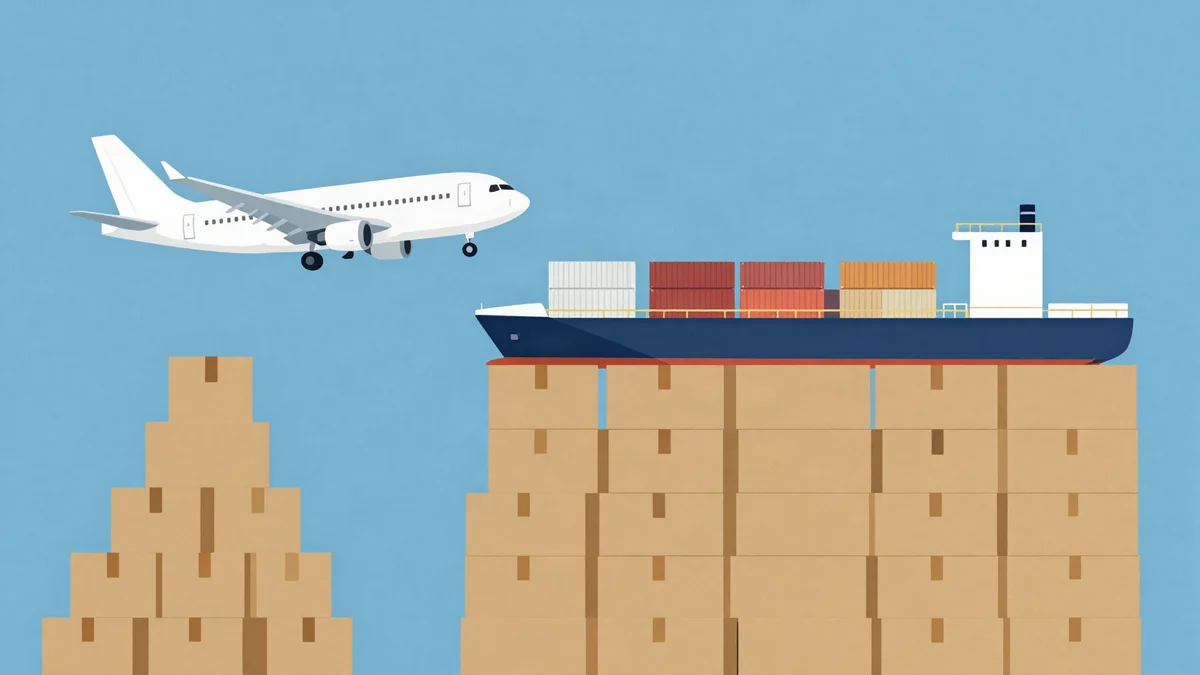
Send most of the order by sea and fly only the units that have to cover the gap until the boat lands. The question is almost never which mode. It is how many units cannot wait, because that number is usually a small fraction of the order, and paying air rates on the whole shipment to protect it is where the money goes.
Why the mode question is the wrong one
Picking air or sea is a choice between two prices. Computing the split is arithmetic, and the answer is normally cheaper than either pure option. You are not buying speed for the order. You are buying speed for the days you would otherwise be out of stock.
This is not our idea. Freight forwarders give the same advice to their own customers. Unicargo, writing on 22 March 2026, puts it as “Split smart: Air/express 20-30% for buffer + ocean bulk”, and cites an apparel brand that combined air, rail and ocean for “27% lower total cost vs pure ocean, 12 days faster to East Coast FCs”. They sell freight, not software, and they have no idea we exist.
What each mode actually charges for
The two are not priced the same way, which is why comparing quotes per shipment misleads you. Per Shopify's own freight guide, published 4 December 2025, “Ocean freight is charged per container or cubic meter” while “air freight uses chargeable weight, the greater of volume or actual mass”.
| Sea | Rail | Air | |
|---|---|---|---|
| Charged on | Container or cubic metre | Container or weight | Chargeable weight, volume or mass |
| Relative transit | Slowest | Between the two | Fastest |
| Suits | Bulk, heavy, low value per kilo | Middle cases | Light, urgent, high margin per kilo |
| Punishes | Anything you needed sooner | Nothing much, which is why it is underused | Anything bulky |
Get quotes for your own lanes rather than trusting a range. Rates move with fuel surcharges, congestion and capacity, and Shopify's guide names all three as sources of variability. A number from a blog post, ours included, is not a quote.
The bridge calculation
The unit you are solving for is days uncovered, not units ordered.
Units to fly = daily sales × (days until the sea order lands − days of stock you have left)
Everything above that number goes on the boat. If the answer is zero or negative, the boat covers you and there is nothing to fly.
A worked example
A product selling 12 units a day, 180 units on the shelf, sea transit and handling of 60 days, air of 7 days. Total order 1,800 units. Each unit weighs 0.4 kg.
- Stock left covers 180 ÷ 12 = 15 days
- The boat lands on day 60, so 45 days are uncovered
- Units to fly: 45 × 12 = 540, which is 30% of the order
- The remaining 1,260 units go by sea
Now price it. Say your quotes work out at $6.50/kg by air and $0.90/kg by sea for these goods. Those are example figures to make the arithmetic visible, not market rates.
| Plan | Freight | Days out of stock |
|---|---|---|
| Everything by air | 720 kg × $6.50 = $4,680 | 0 |
| Split, 540 air and 1,260 sea | $1,404 + $454 = $1,858 | 0 |
| Everything by sea | 720 kg × $0.90 = $648 | 45 |
The split costs $2,822 less than flying it all and arrives just as usefully. Against the all-sea plan it costs $1,210 more, and that is the number people stop at.
The comparison that is missing
All-sea looks cheapest because the cost of the 45 days is not on the freight quote. Put it on.
At 12 units a day and a margin of $14 a unit, 45 days out of stock is 540 units of lost margin, or $7,560. Against that, the $1,210 extra freight is not a cost, it is the price of not losing $7,560.
Air premium ÷ margin earned per selling day = days to pay back. Here: $1,210 ÷ ($14 × 12) = 7.2 days. The bridge pays for itself in a week and then keeps earning.
This is the calculation to run whenever someone says air freight is too expensive. It is often true and sometimes badly wrong, and the only way to tell is to price the days.
When to fly the whole thing
Rare, but real. A product light enough that air is a small share of landed cost, a launch where being late costs you the launch, or a stockout on something that carries the rest of your range. If the payback is a handful of days and the goods are light, the argument for the boat is thin.
When to fly nothing
More common than merchants expect. If you ordered on time, there is no gap, so there is nothing to bridge. Most air freight is not a shipping decision at all. It is the bill for a purchasing decision made three weeks late, which is why the ordering deadline matters more than the freight quote.
What the quote leaves out
Two things routinely break the arithmetic. Production time, which for made-to-order goods can be 30 to 45 days and appears on no freight quote, and customs and putaway, because goods on a dock are not sellable. Both push the real arrival date past the transit estimate, which means the gap you are bridging is longer than it looks.
Volume matters as much as weight for air. Shopify's guide notes air is charged on the greater of volume or mass, so bulky light goods are charged as if they were heavy. Check the chargeable weight before assuming a light product is cheap to fly.
Where this gets hard
The calculation needs your margin per unit and your weights, and plenty of stores do not have reliable numbers for either. If your cost price already includes freight, or your weights are blank, the payback figure is not trustworthy and you should fix the inputs before acting on the output. We would rather say that than hand you a confident answer built on a blank field.
It also assumes demand holds while the goods travel. On a seasonal product where the season ends before the boat lands, the whole frame changes, and the right answer may be to order less rather than to ship it faster.
Common questions
Is air freight ever cheaper than sea freight?
Per kilo, almost never. In total cost it can be, once the margin lost to being out of stock is counted. A useful test is the payback: divide the air premium by the margin you earn per selling day. If the answer is a small number of days, air is paying for itself.
How many units should I send by air?
Only the units that cover the gap. Multiply your daily sales by the number of days between running out and the sea shipment landing. Everything above that goes on the boat. If the result is zero or negative, you ordered in time and nothing needs to fly.
Why is my air quote so high for a light product?
Air freight is charged on chargeable weight, which is the greater of volume or actual mass, so bulky light goods are billed as if they were heavy. Check the chargeable weight rather than the scale weight before assuming a light product is cheap to fly.
What is the difference between FCL and LCL?
Shopify's freight guide describes FCL as reserving an entire container, which gives more control and faster transit, while LCL shares container space and adds consolidation and deconsolidation charges at both ends. LCL suits smaller volumes but the extra handling steps add time and cost per unit. The volume where booking a full container starts beating LCL's per-cubic-metre rate is its own question, covered in our FCL vs LCL guide.
Does splitting an order across two modes complicate receiving?
Yes. One purchase order arrives as two deliveries on different dates, so your receiving process has to accept partial arrivals against the same order and track what is still in transit. If your system cannot do that, the split is harder to run than it is to calculate.
Sources
Every source below was opened and read on the date shown against it. Rules, rates and schedules change, so check the current page before you act on a number that matters. If anything here is out of date or wrong, tell us and we will correct it.
- Unicargo, Air vs Ocean Freight 2026 (22 March 2026) (read 30 August 2026)
- Shopify, Best Freight Forwarding Services for Ecommerce (4 December 2025) (read 30 August 2026)
Marcus co-founded Restocio and works on it daily with a Swedish importer who plans their purchasing in it every working day. Restocio is built in Sweden by two founders, one Swedish and one Danish, and Marcus is the Danish one. Why we are building it.
Related reading
- Sea, rail or air freight for importers
- FCL vs LCL, and the CBM where it flips
- Which SKUs to fly, which to leave on the boat
- How much extra stock to order before Chinese New Year 2027
- Landed cost, and why your margin is wrong without it
- Reorder point formula, with a worked example
- Importing for Shopify, and where to start
- The freight mode toggles, and what turning one off does
Restocio plans purchasing for Shopify stores that import. It works out what to order, how much, and whether it should travel by sea, rail or air, so you pay air freight only for the units that genuinely cannot wait.